
Table of Contents
- Why Do Ontario Cars Rust Faster Than Other Provinces?
- How Does Road Salt Cause Rust?
- Calcium Chloride vs Sodium Chloride Car Damage
- Why Does Rust Start on the Underside of a Car?
- Surface Rust vs Structural Rust: How to Tell Them Apart
- Ontario Car Rust: Key Facts at a Glance
- Why Do Cars Rust in the GTA Specifically?
- Can Rust Cause a Car to Fail Ontario Safety Inspection?
- How Much Rust Is Too Much? Repair or Scrap
- Frame Rust Repair Cost Ontario
- Rust Repair Cost vs Scrap Value
- Floor Pan Rust Repair or Scrap?
- Does Rustproofing Actually Work Against Ontario Winters?
- Frequently Asked Questions
Ontario cars rust faster than vehicles almost anywhere else in Canada because the province spreads roughly 1.5 to 3 million tonnes of road salt on public roads every winter, and that salt combines with a freeze-thaw weather pattern that attacks bare metal on a vehicle’s underside for five to six months a year. A car driven year-round in the GTA, Hamilton, Windsor, or London typically shows visible undercarriage rust within 3 to 5 years. It can develop structural rust — the kind that fails a safety inspection — within 8 to 12 years, roughly twice as fast as a comparable car in Alberta or British Columbia. Once rust reaches the frame, subframe, or floor pan, repair costs frequently exceed the car’s resale value, which is the point where most Ontario mechanics recommend scrapping instead of fixing.
Below, we break down exactly how road salt causes car rust in Ontario, how to spot the difference between rust you can ignore and rust that ends your car’s driving life, and how to turn a rusted car into cash once repair no longer makes financial sense.
Why Do Ontario Cars Rust Faster Than Other Provinces?
If you’ve ever wondered why cars in Ontario rust so much faster than vehicles owned by friends or family out west, it comes down to three overlapping factors: salt volume, weather cycling, and road geography.
Municipal and provincial road authorities are legally required to keep highways clear for winter safety, and salt remains the cheapest, fastest tool available. That means car rust in Ontario winter damage isn’t bad luck — it’s a predictable side effect of how the province keeps roads drivable from November to April.
Southern Ontario has effectively become a rust-belt Ontario car owners joke about at every mechanic shop: heavy traffic corridors, high salt application rates, and humid lake-effect weather around the Great Lakes create ideal conditions for corrosion. Vehicles wintering on the 401, the QEW, or the Gardiner get salt spray flung directly into wheel wells, rocker panels, and the underbody — areas that rarely dry out completely all winter.
Do Cars Rust Faster in Ontario Than Alberta / BC?
Yes. Do cars rust faster in Ontario than in Alberta / BC is one of the most common questions we hear, and the answer is a clear yes for most of the province. Alberta uses more sand and gravel abrasives relative to salt in many regions, and its drier climate means less prolonged moisture contact with metal. British Columbia’s Lower Mainland rarely stays below freezing for long, so salt use is minimal outside the interior. Ontario sits squarely in the freeze-thaw zone with heavy urban salt use, which is why used cars imported from Alberta or the Maritimes often command a premium — buyers know the body carries less accumulated corrosion history
How Does Road Salt Cause Rust?
It is a chemistry question with a mechanical answer. Steel rusts through oxidation — iron reacting with oxygen and water to form iron oxide. Plain water alone causes rust slowly. Salt speeds the process because dissolved chloride ions act as an electrolyte, letting electrons move more freely across the metal surface and accelerating the reaction that eats away steel. Salt-laden slush doesn’t just sit on paint — it works into seams, spot-welds, drain holes, and the stone chips every car picks up on the highway, and once chloride reaches bare metal beneath the paint or undercoating, the clock starts ticking.
How Fast Does Road Salt Rust a Car?
It depends on age, coatings, and driving patterns, but Ontario’s climate compresses the timeline considerably. A well-undercoated new vehicle might not show corrosion for 4 to 6 years. An older vehicle with worn factory rust protection, or one driven daily through slush and parked in a warm garage (which concentrates salt residue), can show pitting within 2 to 3 winters. Vehicles over 10 years old that were never rustproofed are the most vulnerable group we see coming in for scrap evaluations.
The Freeze-Thaw Cycle Car Rust Connection
The freeze-thaw cycle and car rust relationship is often overlooked compared to salt itself, but it’s just as important. Ontario winters swing above and below zero repeatedly between December and March. Each thaw lets salty meltwater seep deeper into metal seams and hairline cracks in undercoating; each refreeze expands that trapped moisture, physically widening the cracks and pushing corrosion further into the metal. This is why Ontario cars often rust from the inside of a panel outward, showing bubbling paint long before a visible hole appears.
Calcium Chloride vs Sodium Chloride Car Damage
Not all winter de-icers are equal, and understanding calcium chloride vs sodium chloride car damage explains why some winters are harder on vehicles than others. Sodium chloride (plain rock salt) is the cheapest and most widely used de-icer on Ontario roads, but independent corrosion testing has found that properly inhibited calcium chloride solutions cause less metal corrosion than sodium chloride at equivalent concentrations — lab comparisons reviewed by corrosion researchers put the difference at roughly 60–90% less corrosion, depending on concentration and inhibitor formulation. Calcium chloride is pricier, so municipalities still rely mainly on sodium chloride for large-scale highway applications.
Where salt brine car damage enters the picture is in liquid pre-wetting and anti-icing programs. Many Ontario municipalities now pre-treat roads with salt brine (a sodium chloride and water solution) before storms hit, which improves ice control but also means roads carry a thin, invisible film of dissolved salt even before visible slush appears. That brine sprays onto vehicles in a fine mist that coats the entire undercarriage — often more evenly and persistently than chunky rock salt would.
Why Does Rust Start on the Underside of a Car?
Why does rust start on the underside of a car rather than the hood or roof comes down to physics: gravity, spray patterns, and drying time. Wheels fling salty slush directly onto the undercarriage, frame rails, and inner fender wells with every rotation, and unlike painted exterior panels, the underside has thinner protective coatings, exposed welds, and drain holes that trap debris and moisture rather than shedding it.
- Undercarriage rust causes include trapped road grime holding moisture against bare metal, factory undercoating cracking with age and stone-chip impact, and poor drainage in body cavities where salt slush pools and never fully dries between drives.
- Brake line rust and road salt damage are one of the most safety-critical outcomes of underside corrosion. Steel brake lines run along the frame, directly exposed to salt spray; once the protective coating degrades, rust can perforate the line from the outside in, leading to brake fluid leaks — one of the most common reasons older Ontario vehicles fail inspection or develop a sudden brake pedal problem in winter.
Surface Rust vs Structural Rust: How to Tell Them Apart
Understanding surface rust vs structural rust is the single most important distinction for any Ontario car owner trying to decide whether a rusty vehicle is still safe and worth keeping.
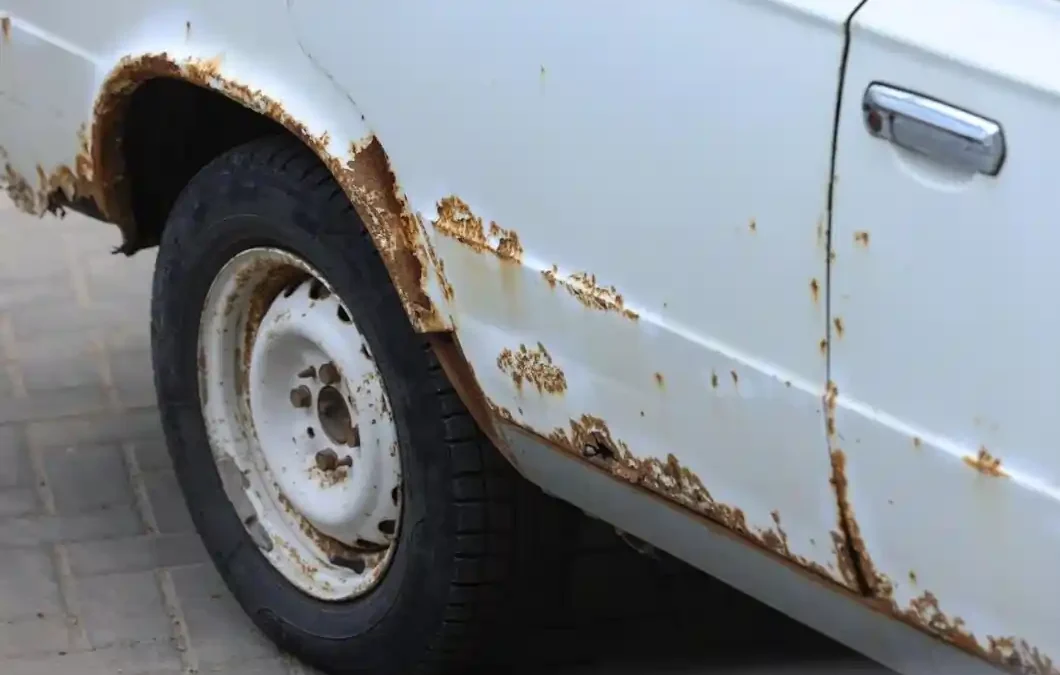
Surface rust is cosmetic. It typically appears as orange discoloration or light flaking on exposed metal — exhaust tips, brake rotors after a rainy weekend, or minor stone chips on rocker panels. It doesn’t compromise strength and, on its own, will not fail a safety inspection.
Structural rust is a different matter entirely. This is corrosion that has eaten through load-bearing components: frame rails, subframes, floor pans, seatbelt anchor points, control arm mounts, or suspension mounting points. Structural rust reduces the vehicle’s crash protection and can eventually create actual holes you can see through. This is the category of damage that determines whether a car is still legally and mechanically fit to drive.
Ontario Car Rust: Key Facts at a Glance
| Factor | Detail |
|---|---|
| Ontario road salt tonnes per winter | Ontario applies an estimated 1.5–3 million tonnes of road salt on public roads annually (Canada-wide totals reach roughly 5–7 million tonnes, including all de-icers) |
| Toronto’s annual salt use | Approximately 130,000–150,000 tonnes per winter on city streets alone |
| Time to first visible rust | As little as 2–3 winters on undercoated, older, or damaged vehicles |
| Time to structural rust risk | Typically 8–12 years for a vehicle driven year-round without rustproofing |
| Rust belt cities in Ontario | Toronto, Hamilton, Windsor, and London see some of the heaviest combined salt use and humidity exposure in the province |
| Calcium chloride vs sodium chloride | Inhibited calcium chloride can cause roughly 60–90% less metal corrosion than sodium chloride in comparable concentrations |
| Surface rust | Cosmetic; does not fail a safety inspection on its own |
| Structural rust | Frame, subframe, floor pan, or mount corrosion; automatic safety inspection failure |
| Typical frame rust repair cost in Ontario | $1,500–$6,000+, depending on severity and whether the frame needs sectioning or replacement |
Why Do Cars Rust in the GTA Specifically?
It is more visible than in some other Ontario regions, which comes down to traffic density and road network size. The GTA has the highest concentration of salted lane-kilometres in the province, dense highway interchanges, and a lake-effect humidity pattern from Lake Ontario that keeps moisture lingering on road surfaces longer after each salting event. Car rust in Toronto winter damage is compounded by daily commuting patterns — stop-and-go traffic on salted roads for months at a time means more exposure hours than a rural driver might accumulate in an entire season. Among rust belt cities, Ontario (Toronto, Hamilton, Windsor, London), Hamilton and Windsor add industrial humidity and proximity to the Great Lakes into the mix, while London sits in the province’s snowbelt and often receives heavier and more frequent salt applications than cities further south.
Can Rust Cause a Car to Fail Ontario Safety Inspection?
Yes – requirements are a question with a clear answer under the province’s Safety Standards Certificate (SSC) process. Surface rust, minor pitting, and cosmetic corrosion will not cause a failure. However, licensed inspectors are required to check frame integrity, body mounts, and load-bearing structures, and any rust that has perforated or significantly weakened those areas results in an automatic fail. According to Ontario’s own safety standards guidance, a vehicle must be free of structural damage or corrosion that could compromise safety before a certificate can be issued — you can review the current requirements directly on the Government of Ontario’s Safety Standards Certificate. Once a vehicle fails for structural rust, the owner must either fund the repair or the car is legally barred from registration or resale as a roadworthy vehicle in Ontario.
Also Read: My Car Failed Safety Inspection in Ontario — Should I Scrap It or Repair It?
How Much Rust Is Too Much? Repair or Scrap
It isn’t just a visual judgment call — it’s a financial one. A reasonable rule mechanics use: if rust has spread beyond a single repairable panel and reached the frame, subframe, or floor pan, repair costs escalate quickly and rarely make economic sense on an older vehicle
Is My Car Too Rusted to Fix?
It usually comes down to three checks:
- Location — Is the rust confined to a fender or rocker panel, or has it reached the frame, floor pan, or suspension mounts?
- Depth — Is it surface flaking, or has it created actual perforation (holes) you can push a screwdriver through?
- Vehicle value — Does the car’s current resale or trade-in value exceed the cost of the repair?
Frame Rust Repair Cost Ontario
Shops typically quote ranges from $1,500 for localized patch welding to $6,000 or more for extensive frame sectioning or subframe replacement — and that’s before addressing any related suspension, brake line, or exhaust damage uncovered during the repair. Labour rates in the GTA for this kind of structural bodywork run high because it requires certified welding and, in many cases, re-inspection and recertification.
Rust Repair Cost vs Scrap Value
This is where the rust-repair cost vs. scrap-value math becomes unavoidable. If a 12-year-old vehicle is worth $2,000–$3,000 on the used market and frame rust repair alone would cost $3,000–$5,000, the repair simply doesn’t pencil out — you’d be spending more than the car’s worth to keep a vehicle that likely has other age-related issues waiting in the wings.
Floor Pan Rust Repair or Scrap?
Floor pan replacement involves cutting out corroded steel, fabricating or sourcing patch panels, and welding in new material — work that can run $800–$2,500 per section depending on how much of the pan is compromised and whether seat mounts or seatbelt anchors are involved. On a vehicle already showing rust in multiple areas, this is rarely a standalone repair; it’s usually a signal that the whole underbody is reaching the end of its life.
Should I Scrap a Car with Rust?
It is ultimately a straightforward comparison: add up realistic repair estimates for every affected area (frame, floor pan, brake lines, exhaust mounts) and compare that total to the car’s actual market value and remaining useful life. If repairs exceed 50–60% of the vehicle’s value, or if structural rust has already failed a safety inspection, scrapping is almost always the financially sound choice — and it’s one you can act on immediately rather than sinking more money into a vehicle that will keep generating rust-related repair bills every winter going forward.
If you’re at that point, you can get cash for a rusted car. Ontario scrap car removal services will pay on pickup, regardless of how much corrosion damage the vehicle has. Reputable Ontario scrap buyers handle the paperwork, towing, and legal transfer of ownership, so there’s no need to attempt repairs just to make the car presentable for sale.
Does Rustproofing Actually Work Against Ontario Winters?
Annual rustproofing — whether oil-based spray, electronic modules, or drip-oil undercoating — can meaningfully slow corrosion, particularly when applied consistently from a vehicle’s early years. It won’t stop rust altogether in a province that salts roads this heavily, but a well-maintained rustproofing program can add several years before structural rust becomes a concern, especially compared to a vehicle that has never been treated. The catch is consistency: rustproofing needs reapplication every year or two, and it’s far less effective once corrosion has already started under paint or undercoating, since the treatment can’t reach metal that’s already compromised.
Conclusion
Ontario’s winters aren’t going to get gentler on vehicles, and neither is the province’s reliance on road salt. Understanding road salt car rust Ontario damage — from the chemistry of chloride corrosion to the freeze-thaw cycles that drive it deeper into metal every season — helps you make a clear-eyed decision about when a car is still worth fixing and when it’s time to let it go. Surface rust is a cosmetic nuisance. Structural rust, brake line corrosion, and floor pan perforation are safety issues with real repair bills attached, and in a market where used vehicle values fluctuate constantly, those bills often outweigh what the car is actually worth.
If your vehicle has reached that point, Scrap Car Buyer Toronto offers straightforward scrap car removal across Toronto and the GTA, with free towing and same-day payment regardless of how much rust damage your car has accumulated. Rather than pouring more money into a frame or floor pan that will keep corroding every winter, turning a rusted vehicle into cash is often the fastest, most practical way to close the chapter and put that money toward something more reliable.
Frequently Asked Questions
Q1. Why do Ontario cars rust faster than cars in other provinces?
Ontario combines heavy annual road salt application with a freeze-thaw climate pattern that keeps salt in contact with vehicle undercarriages for months at a time. Provinces like Alberta and British Columbia either use less salt relative to abrasives or have drier, milder winters that reduce prolonged moisture-and-chloride exposure.
Q2. How much road salt does Ontario use each winter?
Ontario applies an estimated 1.5 to 3 million tonnes of road salt on public roads in an average winter, with the City of Toronto alone using roughly 130,000 to 150,000 tonnes annually. Exact totals vary year to year depending on snowfall and storm frequency.
Q3. How long before a car starts rusting in Ontario?
Visible surface rust can appear within 2 to 3 winters on vehicles without strong rustproofing, while structural rust affecting the frame or floor pan typically develops over 8 to 12 years of year-round winter driving without protective treatment.
Q4. Does rustproofing actually work against Ontario winters?
Yes, when applied consistently every year, rustproofing can meaningfully delay corrosion and extend a vehicle’s structural life. It cannot reverse existing rust or fully eliminate corrosion risk in a province that relies this heavily on road salt.
Q5. Can rust cause a car to fail a safety inspection in Ontario?
Yes. Surface rust alone will not cause a failure, but rust that compromises the frame, subframe, floor pan, or body mounts is treated as a structural safety issue and results in an automatic fail under Ontario’s Safety Standards Certificate process.
Q6. What's the difference between surface rust and structural rust?
Surface rust is cosmetic corrosion on exposed metal that doesn’t affect strength or safety. Structural rust has eaten into load-bearing components like the frame or floor pan, reducing the vehicle’s crash protection and overall safety.
Q7. How much rust is too much to keep driving a car?
If rust has reached the frame, subframe, floor pan, or suspension mounts — or has already caused a safety inspection failure — it’s generally too much to justify continued repair, especially when the repair cost approaches or exceeds the vehicle’s market value.
Related Posts
Buying a Salvage Title Car in Ontario: Risks, Costs & Red Flags
Table of Contents What Is a Salvage Title on a Car? Ontario\'s Vehicle Brands: Salvage vs. Rebuilt vs. Irreparable Why a Car Gets Branded Salvage in the First Place Going From Salvage to Rebuilt: The Ontario Process Where Salvage Title Cars Come From: Auctions in Ontario The Real Risks of…
Title Jumping in Ontario: What Every Car Seller Needs to Know
Table of Contents What Is Title Jumping? Is Title Jumping Illegal? Is It a Crime? How to Properly Transfer Car Ownership in Ontario What Happens If You Don\'t Transfer Ownership If the Seller Won\'t Transfer the Title How to Report Suspected Title Jumping or Fraud How to Avoid Title Jumping…

Vehicle Bill of Sale Ontario: Why It’s Important & How to Get One
Table of Contents What Is a Vehicle Bill of Sale? Why a Bill of Sale Is So Important in Ontario Ontario\'s Legal Requirements Where to Get a Bill of Sale in Ontario How to Write a Bill of Sale for a Vehicle Bill of Sale vs. Car Sale Purchase Agreement…
The Certificate of Destruction: Your Legal Proof When a Car Is Scrapped
Table of Contents What is a certificate of destruction? Why Do You Need a Certificate of Destruction? Certificate of Destruction in Ontario: RPRA vs. EASR Do I Need a Certificate of Destruction to Scrap My Car in Ontario? What Documents Do I Need to Scrap My Car in Canada? What…

Free Ontario Used Vehicle Bill of Sale Template (2026)
Table of Contents What Is a Bill of Sale, and Do You Actually Need One in Ontario? What has to be on a Used Vehicle Bill of Sale As-Is vs. Certified - Which Box Do You Check? How to Fill Out a Used Vehicle Bill of Sale Not Selling Privately?…
What Is a Scrap Transmission Worth in Canada?
Table of Contents How Much Is a Transmission Worth for Scrap in Toronto? Scrap Transmission Price Per Pound in Ontario Aluminum vs. Steel Transmission Scrap Price Automatic vs. Manual vs. CVT Scrap Value How Much Do Transmissions Weigh? Scrap Value vs. Transmission Cost What Affects the Price? Where to Sell…
What Is an Electric Motor from a Scrap Car Worth in Canada?
Table of Contents How Much Is an Electric Motor from a Scrap Car Worth Right Now? Car With a Blown Motor vs. Selling Electric Parts Separately What Actually Drives Electric Motor Scrap Prices Electric Motors Found in a Car — and What Each One Is Worth Who\'s Asking This, and…
Catalytic Converter Theft Is Hitting Toronto Hard — What to Do If Yours Is Targeted
Table of Contents Why Toronto Is a Hotspot for Catalytic Converter Theft How to Tell If Your Catalytic Converter Was Stolen Will your car start if someone steals your catalytic converter? What should I do if someone steals my catalytic converter? Why Catalytic Converters Are Stolen (And What Thieves Do…

Where to find customer reviews for scrap car parts retailers in Canada?
Table of Contents Why Review Research Matters Before You Sell to a Scrap Yard Best Websites to Read Scrap Yard Reviews Are Google Reviews Reliable for Auto Salvage Yards? Is BBB Good for Checking Scrap Car Buyers? How Do I Know If a Scrap Yard Is Legit? What to Look…
The “Bait-and-Switch” Scrap Car Scam Costing Toronto Drivers Hundreds
Table of Contents What Is a Bait-and-Switch Scrap Car Scam? How It Actually Plays Out Why the Price Drops on Arrival Is It Legal for a Buyer to Change the Price at Pickup? Licensed vs. Unlicensed Scrap Car Buyer in Toronto What Actually Determines a Fair Scrap Value Signs of…