
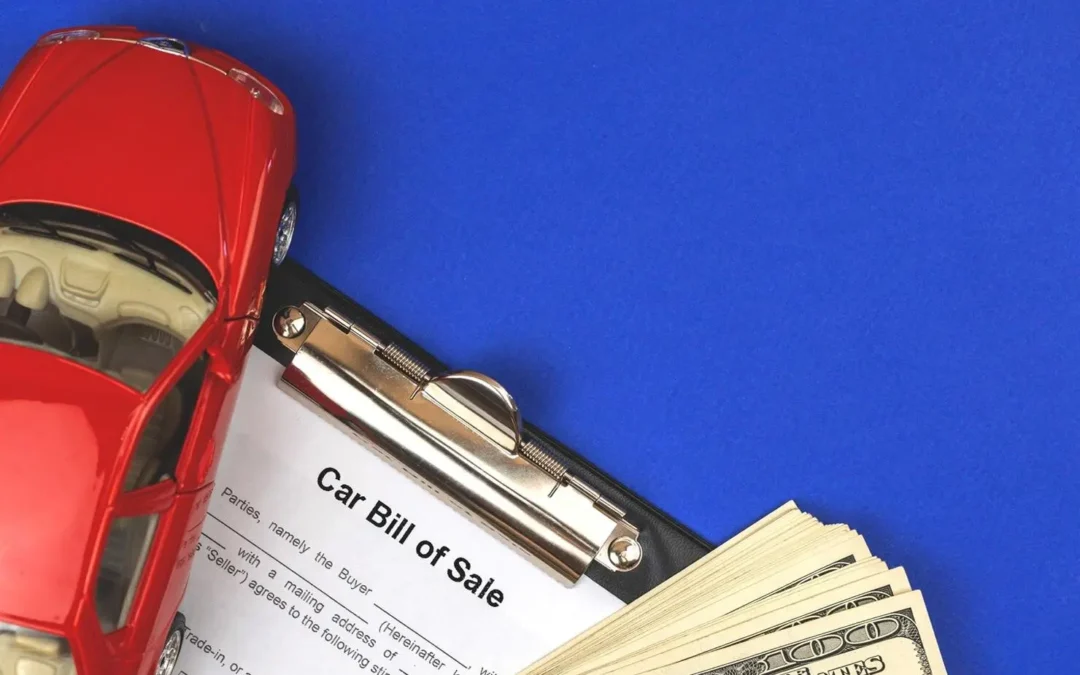
Table of Contents
- What Is a Vehicle Bill of Sale?
- Why a Bill of Sale Is So Important in Ontario
- Ontario’s Legal Requirements
- Where to Get a Bill of Sale in Ontario
- How to Write a Bill of Sale for a Vehicle
- Bill of Sale vs. Car Sale Purchase Agreement
- Special Situations: Gifts, Out-of-Province & Scrap Vehicles
- Key Points at a Glance
- Common Mistakes to Avoid
- Frequently Asked Questions
A vehicle bill of sale in Ontario is a signed record proving a car changed hands from a seller to a buyer for an agreed price. It’s built into Ontario’s Used Vehicle Information Package (UVIP), it’s the document ServiceOntario uses to calculate your 13% Retail Sales Tax, and it’s your main legal proof of purchase if a dispute or insurance question comes up later. You can get one free inside the UVIP, from a printable Ontario bill of sale template, or by writing your own — as long as it includes the required details below.
What Is a Vehicle Bill of Sale?
It’s the receipt for one of the most valuable items most people ever buy privately. Without it, there’s no independent record that the sale happened on the terms both sides agreed to. In Ontario, a bill of sale for a car does three jobs:
- Proves ownership transfer — who owned the vehicle, and when.
- Proves the sale price — used by ServiceOntario to calculate tax owed.
- Protects both parties legally — evidence in a dispute, chargeback, or lien issue.
Why a Bill of Sale Is So Important in Ontario
It’s your tax record. When you buy privately, the seller doesn’t collect sales tax — you pay 13% Retail Sales Tax (RST) to ServiceOntario when you register the car, calculated on whichever is higher: your bill-of-sale price or the vehicle’s average wholesale (“Red Book”) value. A missing, unsigned, or vague bill of sale can mean getting taxed on the higher wholesale figure by default.
It’s your legal shield after the sale. You’re technically still tied to a vehicle until ownership is transferred at ServiceOntario. A signed, dated bill of sale proves you sold it on a specific date — protection against tickets or liability claims tied to the car after you hand over the keys.
It’s your evidence if something goes wrong. If a cheque bounces or a seller misrepresents mileage or condition, a bill of sale is usually the single most important document in a Small Claims Court case — courts and insurers weigh a signed document far more heavily than a text thread.
It’s required for registration. ServiceOntario won’t transfer ownership into your name without one.
The Ontario Motor Vehicle Industry Council (OMVIC), which regulates vehicle sales in the province, advises buyers and sellers to treat the paperwork around a used-car deal as seriously as the vehicle itself. See OMVIC’s consumer guidance.
Ontario's Legal Requirements
Ontario has no single mandatory form, but it does mandate what the paperwork must contain and how the process works.
The UVIP is the backbone of every private sale. Under the Highway Traffic Act, a private seller must provide the buyer with a UVIP before the sale closes. It includes the vehicle’s Ontario registration history, lien status, wholesale value — and a bill of sale section on its final page that both parties sign. You can order one online through the Ontario government or in person at ServiceOntario.
A bill of sale for a car in Ontario should include:
- Full names and addresses of buyer and seller
- VIN, make, model, year, and colour
- Odometer reading at time of sale
- Sale price and exact transaction date
- Condition statement (e.g., “sold as-is”)
- Both signatures
Registration deadline: The buyer must register the vehicle at ServiceOntario within 6 days of the purchase date, bringing the signed UVIP/bill of sale, a completed Application for Transfer, proof of insurance, and usually a valid Safety Standards Certificate (SSC).
About the SSC: Most private transfers require an SSC from a licensed inspection station, valid for 36 days. Vehicles can be sold “as-is” without one, but the buyer can’t plate, insure, or register it for road use until it passes inspection — relevant if the car is headed for scrap rather than the road.
For current official requirements, see Ontario’s Used Vehicle Information Package.
Where to Get a Bill of Sale in Ontario
- Inside the UVIP — the simplest, most widely accepted option for private sales; already formatted for ServiceOntario.
- A free printable template — for a standalone document signed at the moment of sale. We offer a free, ready-to-print Ontario used vehicle bill of sale template for 2026 covering every field ServiceOntario expects.
- Write your own — Ontario has no mandatory standalone form; a typed or handwritten document is valid if it covers the required fields above.
- From a licensed dealership — dealers issue their own bill of sale or purchase invoice, and a UVIP isn’t required for OMVIC-registered sellers.
- From a scrap or salvage buyer — a licensed scrap yard or recycler typically provides its own proof-of-sale form when picking up a vehicle that won’t be re-registered.
How to Write a Bill of Sale for a Vehicle
1. Header it. Title the document “Bill of Sale” and include the date and location.
2. Identify both parties. Full legal name, address, and phone number.
3. Describe the vehicle precisely. All 17 VIN characters, year, make, model, trim, colour, and odometer reading.
4. State price and payment method. State the agreed price in CAD and how it was paid.
5. Declare condition. Note “as-is” or warranty terms, and disclose known issues.
6. List any liens. Resolve any lien the UVIP shows before completing the sale.
7. Sign and date. Both parties keep a signed copy; a witness signature adds extra proof.
A properly written motor bill of sale takes about ten minutes — a small investment for a document that can matter for years.
Bill of Sale vs. Car Sale Purchase Agreement
A bill of sale is a short, transactional proof-of-sale record: what sold, to whom, for how much, and when. A car sale purchase agreement is a more detailed contract — used for financing, staged payments, or dealership deals — that can cover financing terms, trade-ins, and warranties.
For most private Ontario sales (one buyer, one seller, paid in full at transfer), a bill of sale is all you need. A purchase agreement matters more when payment is staggered or extra contractual terms apply.
Special Situations: Gifts, Out-of-Province & Scrap Vehicles
Family gifts. Transfers to an eligible family member (spouse, parent, child, sibling, grandparent) can be RST-exempt, but you still need a Sworn Statement for a Family Gift form — a bill of sale alone doesn’t secure the exemption.
Out-of-province purchases. Bringing in a used vehicle from outside Ontario still requires a bill of sale documenting the price, plus an Ontario-issued Safety Standards Certificate before you can register and plate it here.
Selling for scrap or parts. A vehicle that’s no longer roadworthy doesn’t need a UVIP or SSC to sell to a licensed scrap buyer, since it isn’t being re-registered. A simple bill of sale is still recommended as a paper trail showing you’re no longer liable for the vehicle. If you’re weighing options for an old or damaged car in the GTA, see our guides to scrap car removal in Toronto and getting cash for a scrap car.
Key Points at a Glance
| Requirement | Private Sale | Dealership Sale | Scrap / Salvage Sale |
|---|---|---|---|
| Bill of sale required? | Yes — built into UVIP | Yes — dealer invoice/contract | Recommended, not mandatory |
| Tax type | 13% RST, paid by buyer | 13% HST, collected by dealer | Not applicable |
| UVIP needed? | Yes | No | No |
| Safety Standards Certificate | Usually, unless "as-is" or spousal | Handled by dealer if applicable | Not required |
| Registration deadline | Within 6 days | Often dealer-handled | Not applicable |
| Minimum info required | VIN, price, date, names, odometer, signatures | Same, plus dealer licence | VIN, price, date, names, signatures |
Common Mistakes to Avoid
- Leaving the price blank or vague invites a tax dispute at ServiceOntario.
- Skipping signatures — an unsigned bill of sale carries little legal weight.
- Forgetting the odometer reading, which protects both sides later.
- Not keeping a copy — both parties should leave with one.
- Missing the 6-day registration window, which can leave the seller exposed.
- Accepting cash with no paperwork at all — no bill of sale, no proof the sale happened.
Conclusion
A vehicle bill of sale isn’t a formality — it determines how much tax you pay, protects you legally after the sale, and gives you solid proof if a dispute arises. Whether you’re buying, selling privately, or retiring an old vehicle entirely, getting the paperwork right takes minutes and pays off for years.
Planning to sell privately? Grab our free Ontario used vehicle bill of sale template before you meet a buyer. If your car is old, damaged, or not worth fixing, Scrap Car Buyer Toronto can walk you through a properly documented sale from quote to pickup.
Frequently Asked Questions
Q1. What is a bill of sale for a car in Ontario?
A signed document recording that a specific vehicle was sold from one person to another for an agreed price on a set date, typically completed within the UVIP for private sales.
Q2. Is a bill of sale legally required in Ontario?
A UVIP — which includes a bill of sale — is legally required for private used-vehicle sales under the Highway Traffic Act. A standalone bill of sale isn’t separately mandated, but it’s needed in practice to register the vehicle and protect both parties.
Q3. Where can I get a bill of sale in Ontario?
Through the UVIP’s bill of sale page, a free downloadable template, a document you write yourself, or one provided by a dealership or licensed scrap buyer, depending on the transaction.
Q4. Do I need a separate bill of sale if I already have a UVIP?
Not necessarily — the UVIP’s final page is a valid bill of sale once signed by both parties. Some buyers and sellers still prefer a more detailed standalone version for clarity.
Q5. How do I write a bill of sale for a vehicle myself?
Include both parties’ names and addresses, the VIN, make, model, year, odometer reading, sale price, date, condition, and both signatures — see the step-by-step checklist above.
Q6. What’s the difference between a bill of sale and a car sale purchase agreement?
A bill of sale is a short proof-of-sale record; a purchase agreement is a longer contract for financing or staged payments. Most private used-car sales only need a bill of sale.
Q7. Do I need a bill of sale to scrap or sell my car for parts?
It’s not legally mandatory the way a roadworthy transfer is, but it’s strongly recommended as proof you’re no longer responsible for the vehicle.
Q8. Can I use a bill of sale as proof of sale for insurance purposes?
Yes. Insurers generally accept a signed, dated bill of sale as valid proof of sale price and ownership transfer, alongside your UVIP and registration paperwork.
Related Posts
The Certificate of Destruction: Your Legal Proof When a Car Is Scrapped
Table of Contents What is a certificate of destruction? Why Do You Need a Certificate of Destruction? Certificate of Destruction in Ontario: RPRA vs. EASR Do I Need a Certificate of Destruction to Scrap My Car in Ontario? What Documents Do I Need to Scrap My Car in Canada? What…

Free Ontario Used Vehicle Bill of Sale Template (2026)
Table of Contents What Is a Bill of Sale, and Do You Actually Need One in Ontario? What has to be on a Used Vehicle Bill of Sale As-Is vs. Certified - Which Box Do You Check? How to Fill Out a Used Vehicle Bill of Sale Not Selling Privately?…
What Is a Scrap Transmission Worth in Canada?
Table of Contents How Much Is a Transmission Worth for Scrap in Toronto? Scrap Transmission Price Per Pound in Ontario Aluminum vs. Steel Transmission Scrap Price Automatic vs. Manual vs. CVT Scrap Value How Much Do Transmissions Weigh? Scrap Value vs. Transmission Cost What Affects the Price? Where to Sell…
What Is an Electric Motor from a Scrap Car Worth in Canada?
Table of Contents How Much Is an Electric Motor from a Scrap Car Worth Right Now? Car With a Blown Motor vs. Selling Electric Parts Separately What Actually Drives Electric Motor Scrap Prices Electric Motors Found in a Car — and What Each One Is Worth Who\'s Asking This, and…
Catalytic Converter Theft Is Hitting Toronto Hard — What to Do If Yours Is Targeted
Table of Contents Why Toronto Is a Hotspot for Catalytic Converter Theft How to Tell If Your Catalytic Converter Was Stolen Will your car start if someone steals your catalytic converter? What should I do if someone steals my catalytic converter? Why Catalytic Converters Are Stolen (And What Thieves Do…

Where to find customer reviews for scrap car parts retailers in Canada?
Table of Contents Why Review Research Matters Before You Sell to a Scrap Yard Best Websites to Read Scrap Yard Reviews Are Google Reviews Reliable for Auto Salvage Yards? Is BBB Good for Checking Scrap Car Buyers? How Do I Know If a Scrap Yard Is Legit? What to Look…
The “Bait-and-Switch” Scrap Car Scam Costing Toronto Drivers Hundreds
Table of Contents What Is a Bait-and-Switch Scrap Car Scam? How It Actually Plays Out Why the Price Drops on Arrival Is It Legal for a Buyer to Change the Price at Pickup? Licensed vs. Unlicensed Scrap Car Buyer in Toronto What Actually Determines a Fair Scrap Value Signs of…
Are there specific requirements for scrapping a larger commercial vehicle?
Table of Contents What Counts as a \"Larger Commercial Vehicle\" in Ontario? Requirements for Scrapping a Commercial Vehicle How to Scrap a Commercial Vehicle in Ontario: Step by Step Documents Needed to Scrap a Commercial Vehicle Difference Between Scrapping a Car and a Commercial Vehicle Can a Business Scrap a…
How Scrap Car Prices Change With Metal Market Swings
Table of Contents Why Scrap Car Prices Rise and Fall Week to Week Ferrous vs. Non-Ferrous: Two Completely Different Pricing Systems The Catalytic Converter Wildcard Battery Metals and Your Scrap Offer How Ontario Reacts to Global Metal Shortages Why Toronto Rates Can Beat the Rest of Ontario Why Two Similar…
Why Ontario Cars Rust Out Faster: Road Salt and When to Scrap
Table of Contents Why Do Ontario Cars Rust Faster Than Other Provinces? How Does Road Salt Cause Rust? Calcium Chloride vs Sodium Chloride Car Damage Why Does Rust Start on the Underside of a Car? Surface Rust vs Structural Rust: How to Tell Them Apart Ontario Car Rust: Key Facts…

Your eco-friendly choice for clutter-free driveways and fuller wallets!
Business Hours
Mon-Sun: 8am – 9pm